TL;DR: A RoPA - Record of Processing Activities - is the document required by Article 30 of the GDPR that maps how an organisation processes personal data: what it collects, why, who it shares it with, and how long it keeps it. It is an internal accountability record, not something you publish, but it is the first document a supervisory authority asks to see in an investigation. Most organisations need one, it has to be accurate and current, and a DPIA does not substitute for it.
If a data protection regulator opens an investigation into your organisation, there is a good chance the first thing they ask for is your RoPA. Not your privacy policy, not your consent banners, the record of what personal data you process and why. It is the document that shows, in one place, whether you actually know what your organisation does with people's data.
Many organisations discover, at exactly that moment, that theirs is incomplete.
What a RoPA is?
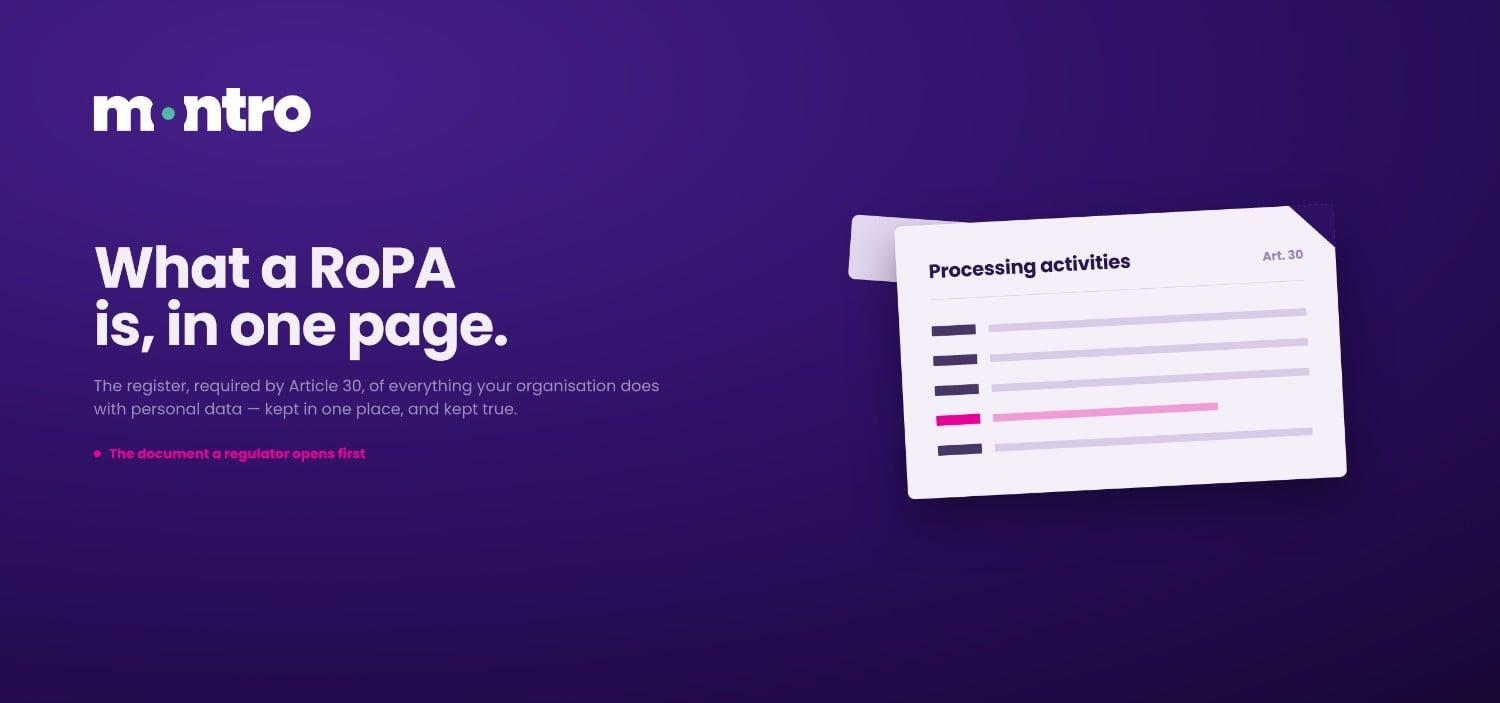
RoPA stands for Record of Processing Activities. It is the internal inventory, required by Article 30 of the GDPR, of every activity through which an organisation processes personal data.
In plain terms, it answers four questions about every processing activity: what personal data you hold, why you hold it, who you share it with, and how long you keep it. Put together across the whole organisation, those answers form a map of your data - where it comes in, where it flows, and where it leaves.
The RoPA is not a public document. You do not publish it the way you publish a privacy notice. It is an internal governance record, kept in writing - electronic form is fine, and made available to a supervisory authority on request.
Its purpose is accountability: it is one of the main ways an organisation demonstrates the accountability principle the GDPR is built on.
Why it matters more than it looks
On paper the RoPA can read like a filing obligation, a form to complete and store. In practice it is the document regulators reach for first, because it reveals more than its contents.
A complete, current RoPA tells a supervisory authority that the organisation knows what processing it carries out and has thought about why. An incomplete or out-of-date one tells them the opposite, before a single specific question is asked. The record is a proxy for whether the organisation is in control of its own data, which is exactly what an investigation is trying to establish.
This is also why a related document will not stand in for it. Organisations sometimes offer their Data Protection Impact Assessments as evidence of Article 30 compliance. A regulator will not accept that: the RoPA is a standalone record with its own required content, and a DPIA - however thorough, does not replace it.
What Article 30 requires it to contain
Article 30 sets out specific content, and this is where a vague "data inventory" and a compliant RoPA diverge.
For a controller, the record has to cover, for each processing activity: the purposes of the processing; the categories of data subjects and of personal data; the categories of recipients; transfers to third countries and their safeguards; retention periods where possible; a general description of the security measures; and the contact details of the controller and any Data Protection Officer.
The test is not whether a document exists. It is whether it holds this content, accurately, for every activity - which is a higher bar than most spreadsheets clear.
What a single entry looks like
The requirements are easier to picture as one row of the record. Take a common activity: running payroll.
A RoPA entry for it would state the purpose, administering employee pay and meeting tax and social-insurance obligations. It would list the data subjects (current and former employees) and the categories of personal data (names, bank details, salary, tax identifiers, and possibly special-category data such as the health information behind sick pay).
It would name the recipients - the payroll provider, the revenue authority, the pension scheme, and note whether any sit outside the EU, with the safeguard relied on if so. It would record the retention period, how long payroll records are kept after employment ends, and a short description of how the data is secured.
One activity, and already the entry touches three external recipients, a possible transfer, special-category data and a retention rule. A mid-sized organisation runs dozens of activities like this. The RoPA is all of them, held accurately at once, which is why it is more demanding to maintain than the one-page template it is often mistaken for.
Controller and processor RoPAs are different
A point that trips organisations up: the record a controller keeps and the record a processor keeps are not the same document.
A controller - the organisation that decides why and how personal data is processed, keeps the fuller record described above. A processor - an organisation processing data on a controller's behalf, keeps its own separate record, listing each controller it acts for, the categories of processing it carries out for them, any third-country transfers, and its security measures.
An organisation can be both at once, a controller for some activities and a processor for others, and then it needs to account for both roles.
Getting the role right matters, because it determines what the record has to contain and what a regulator will expect to see.
Who actually needs one
There is a common belief that the RoPA is only for large organisations. It comes from a real exemption, but the exemption is narrower than it sounds.
Article 30(5) offers a partial exemption to organisations with fewer than 250 employees. But it falls away, and the obligation returns - if the processing is likely to result in a risk to people's rights and freedoms, if it is not occasional, or if it includes special-category data or data about criminal convictions.
In practice, an organisation that runs payroll, keeps a customer database, sends marketing email or uses analytics is processing data that is "not occasional", so the exemption rarely applies. Most organisations of any real activity need a RoPA, regardless of headcount.
The hard part: keeping it true
Writing a RoPA once is not the difficult bit. Keeping it accurate is.
A RoPA is only useful, and only compliant - if it reflects what the organisation actually does now, not what it did when the record was drafted. Processing activities change constantly: a new tool is adopted, a workflow is rewired, a team starts sending data somewhere it did not before.
Every one of those changes can make the record wrong, quietly, without anyone touching the document. A RoPA that was accurate a year ago and has not been maintained is not a compliant RoPA; it is a historical one.
This is the real work of Article 30, and it is where most RoPAs fail. The record has to keep pace with an organisation whose data processing keeps moving, and a record maintained on a calendar rather than against reality falls behind between reviews.
There is a quieter limit too. A RoPA can only account for the processing an organisation knows it does; anything happening through tools or flows nobody recorded never reaches the record, however carefully the known entries are kept. The distance between what the record shows and what the organisation actually does is where accountability, and the RoPA's whole purpose, quietly comes apart.
Frequently asked questions
What does RoPA stand for?
RoPA stands for Record of Processing Activities. Montro notes it is the document required by Article 30 of the GDPR in which an organisation records how it processes personal data - what it collects, the purposes, who it is shared with, transfers, retention and security measures.
It is an internal accountability record, kept in writing and produced for a supervisory authority on request.
Is a RoPA legally required?
For most organisations, yes. Montro's reading is that Article 30 requires controllers and processors to maintain a RoPA, and while Article 30(5) offers a partial exemption below 250 employees, it is narrow, it does not apply where processing risks people's rights, is not occasional, or involves special-category or criminal-conviction data.
In practice, any organisation running normal business processing needs one.
What is the difference between a RoPA and a DPIA?
They are different documents with different jobs. A RoPA is the standing inventory of all your processing activities under Article 30; a Data Protection Impact Assessment analyses the risks of a specific high-risk activity.
A DPIA does not satisfy the Article 30 obligation, a supervisory authority expects the RoPA as a standalone record, and will not accept DPIAs in its place.
How often should a RoPA be updated?
A RoPA has to stay accurate to remain compliant, so it should be updated whenever processing changes rather than on a fixed calendar alone. New tools, new data flows and new recipients all change what the record should say. A RoPA reviewed once and left to age stops reflecting reality, and a record that no longer matches the organisation's actual processing does not demonstrate the accountability Article 30 exists to show.