Every vendor in this category will show you a clean dashboard, a framework-mapping table and a page of logos. Most of it is real. None of it tells you the thing you actually need to know before you buy: whether the software will still be accurate on the day a supervisor asks a question you did not rehearse.
Evaluating AI risk software for a financial entity is less about comparing feature lists and more about finding where each tool quietly assumes the hard part is already done.
This assumes you already know what these tools are and how classification feeds DORA; if not, start with What AI Risk Classification Software for DORA Actually Means. With that settled, here is how to run the evaluation, the questions that separate software that covers the work from software that decorates it.
Start with the regimes it actually has to serve
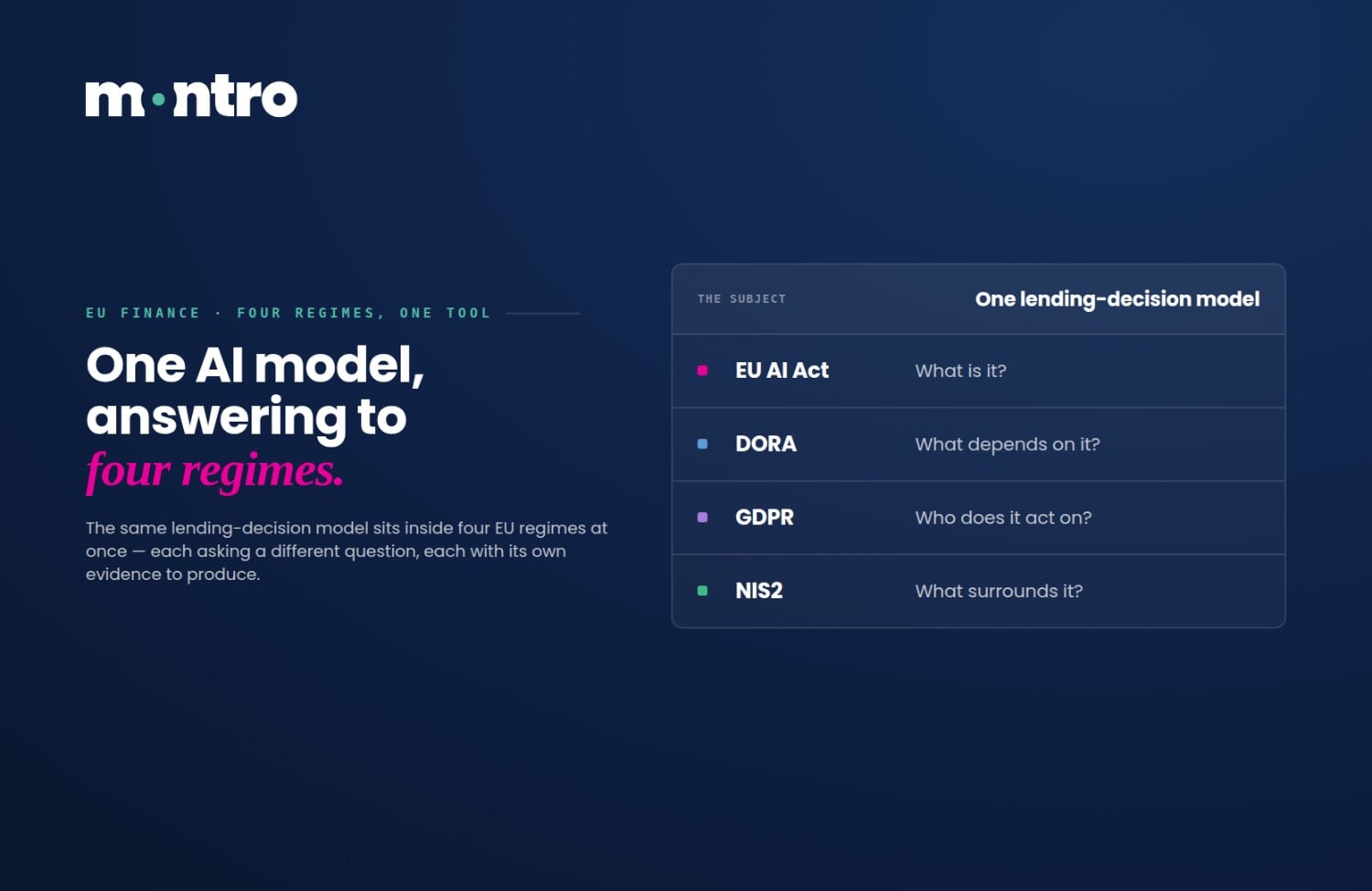
A financial entity in the EU is not buying against one framework. The same AI tool can sit inside DORA's operational-resilience regime, the EU AI Act's high-risk obligations, NIS2's cybersecurity duties and GDPR's automated-decision rules at once.
Financial services has the highest density of named high-risk AI use cases of any sector - credit scoring and insurance pricing are explicitly high-risk under the AI Act.
So the first evaluation question is not "does it do AI risk" but "which regimes does it actually cover, by name, and how." A tool that maps to the AI Act but is silent on DORA's asset and incident obligations has covered one regime of four, and for a financial entity, rarely the heaviest one. Ask for the named mapping, not the marketing claim.
Ask what feeds it before you ask what it shows
This is the question most buyers skip, and it is the one that decides whether the rest of the tool means much. Every AI risk platform works from an inventory of AI systems. Its scoring, its dashboards, its framework mapping all assume that inventory is complete.
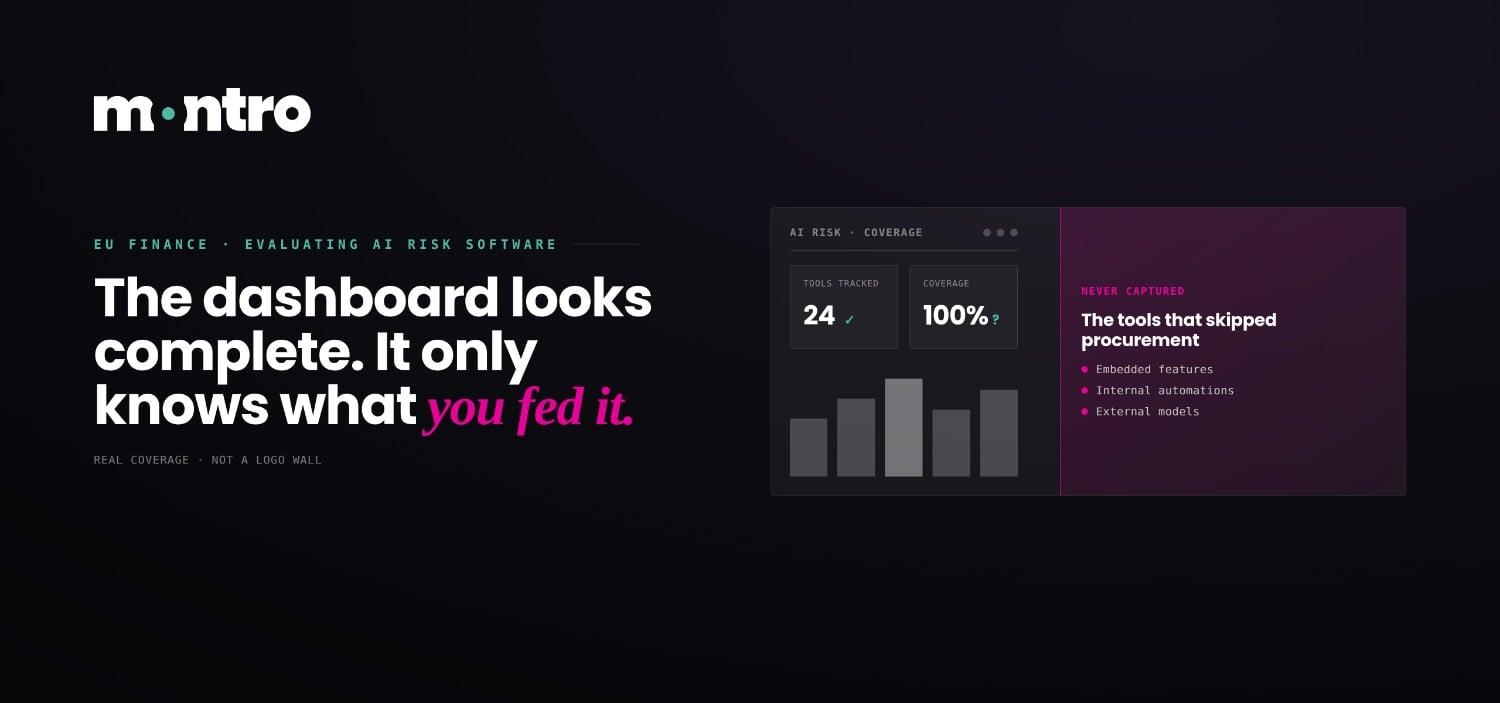
Ask directly: where does the list of AI systems come from? If the answer is "you import it" or "it syncs from your CMDB", then the tool inherits whatever your existing inventory already missed, and for AI, what it missed is usually the embedded features, the internal automations and the external models that never went through procurement.
A platform that scores a partial inventory produces confident numbers about the wrong estate. The dashboard will look complete. It will be complete about the tools you already knew.
The strongest tools either perform discovery themselves or integrate with something that does. The weakest present classification and scoring as the whole job and stay quiet about where the list comes from. That silence is the single most useful thing to probe in a demo.
Check whether AI risk sits in the main register or a side one
A common and revealing gap: AI risk tracked separately from everything else.
Ask whether the AI tools the software governs live in the same ICT asset and risk register as the rest of the estate, mapped to the same functions, or whether "AI governance" is a bolt-on module with its own list.
Under DORA, an AI system is an ICT asset like any other; software that treats AI risk as a separate world quietly recreates the fragmentation DORA exists to remove. One register, many tools - not many registers, one per buzzword.
Don't skip the ordinary due diligence
The questions above are the ones specific to AI risk under EU financial regulation. They sit on top of the ordinary checks any software purchase deserves, and those matter just as much, a tool can be strong on discovery and weak on the basics.
Ask where the data lives, since EU data residency is often non-negotiable for a regulated entity. Ask how it fits the GRC stack you already run, because a tool that cannot exchange data with your existing register and workflow becomes another silo.
Ask how evidence comes out - whether an auditor can be handed a clean, exportable record rather than a login to yet another dashboard. And ask the usual questions about security posture, support and price that you would of any vendor. None of these is AI-specific, and all of them can sink an otherwise capable tool.
Test the mapping against a real obligation, not a logo
Framework logos on a website mean little. What matters is whether the mapping reaches a specific obligation you will be held to. Take one concrete duty - placing a critical AI tool in the asset register with its dependencies, or assessing an AI failure against the incident-reporting thresholds, and ask the vendor to show it done, end to end, in the product.
A tool that can walk one real obligation from input to evidence tells you more than one that lists twelve frameworks it "supports". Depth on one beats breadth on a logo wall.
Ask where the judgement stops and the automation starts
Draw the line in the right place here. Automating discovery is good and worth paying for, finding the tools is exactly the kind of work software should take off a human.
What no tool should claim is to automate the judgement that follows. Deciding what an AI tool is, which function it truly supports and how critical it is remains informed judgement - the software should structure and record that judgement, not pretend to make it for you.
A vendor honest about this is describing a tool that fits how the work actually runs. A vendor claiming to automate the classification judgement itself is describing a tool that will make confident, unaccountable decisions someone still has to defend to a regulator. The honest answer is the more trustworthy one.
What good looks like, in one line
Put the questions together and a pattern emerges. Good AI risk software for EU finance covers the regimes by name, is honest about where its inventory comes from, keeps AI in the same register as everything else, can walk a real obligation end to end, and is clear about where human judgement stays. Weak software has an impressive dashboard and a quiet assumption that discovery, completeness and judgement are somebody else's problem.
The evaluation, in the end, is not really about the software. It is about whether the tool is honest about the parts it does not do, because those parts do not disappear when a vendor stops mentioning them. They just become yours to answer for.
Frequently asked questions
What should you look for when evaluating AI risk software for EU financial services?
Montro's position is that the decisive questions are about coverage and honesty, not features. Check which regimes it maps to by name - DORA, the EU AI Act, NIS2, GDPR - rather than accepting a general "AI risk" claim; ask where its inventory of AI systems comes from, since a tool scoring a partial list produces confident numbers about the wrong estate; and confirm it keeps AI risk in the same register as other ICT assets rather than a separate module.
The best tools are candid about where automation stops and human judgement begins.
Does AI risk software make a financial entity DORA-compliant?
No. Software supports compliance; it does not deliver it. A tool can structure classification, map controls and produce evidence, but it works from the inventory it is given and the judgements a person makes. If the AI tools that matter never reach the inventory, the embedded features and internal models that arrived without procurement, the software governs a partial estate, however polished its output. Discovery and informed judgement remain the entity's own responsibility.
Which regulations should AI risk software cover for EU finance?
For an EU financial entity, a single high-risk AI tool can engage DORA (ICT risk, asset classification, incident reporting, third-party oversight), the EU AI Act (high-risk obligations for use cases such as credit scoring and insurance pricing), NIS2 (broader cybersecurity and supply-chain duties) and GDPR (automated-decision and data-protection rules).
Software that addresses only one of these has covered only part of the obligation, so named, per-regime mapping is the thing to verify.
Is a dashboard enough to evaluate AI risk software?
No. A dashboard shows what the tool already knows; it says nothing about what the tool never captured. The more useful test is to take one real obligation, placing a critical AI tool in the asset register, or assessing an AI failure against incident thresholds, and ask the vendor to demonstrate it end to end. Depth on a single genuine obligation is more informative than a wall of framework logos.