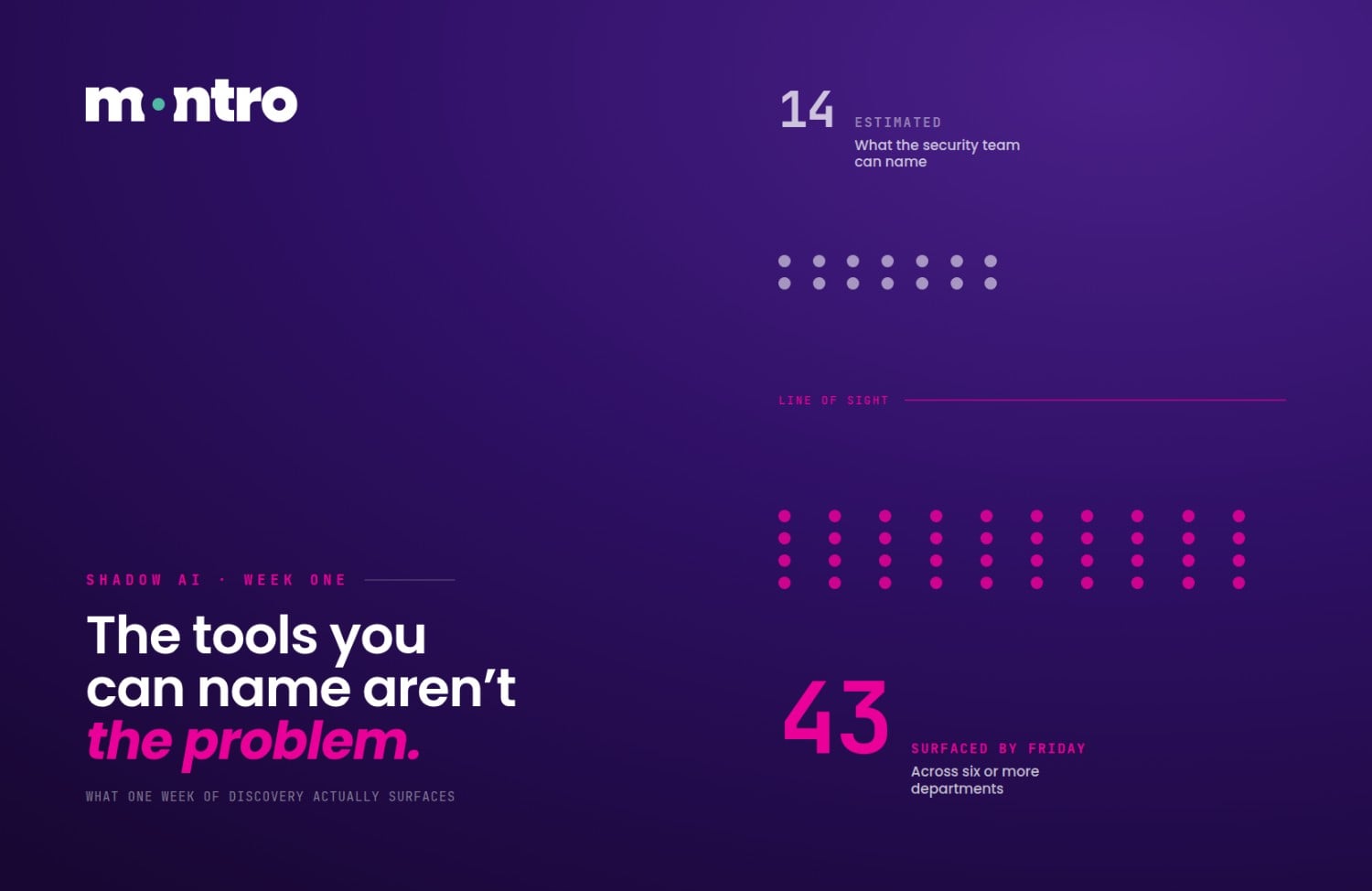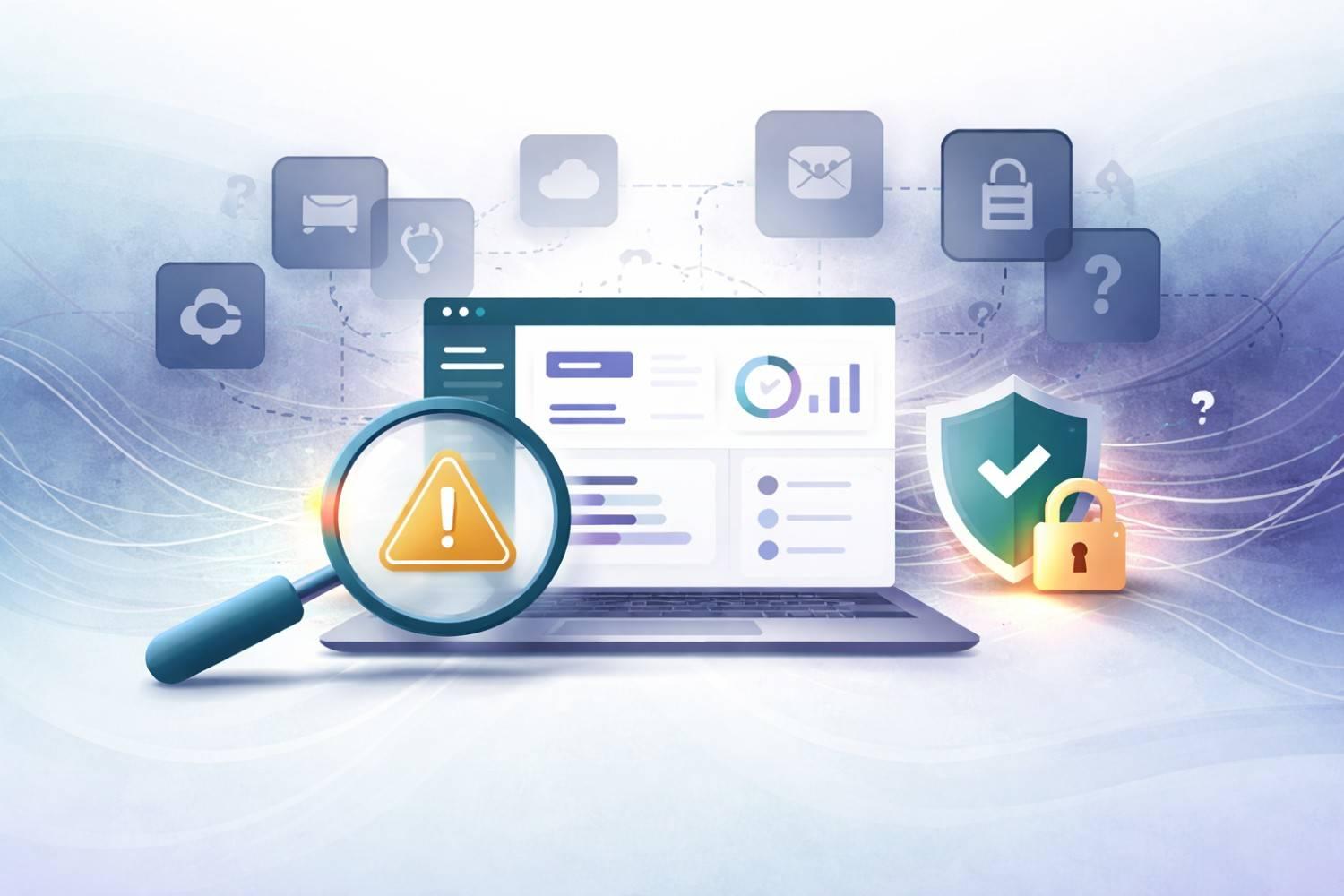
Security controls are only as effective as the environment they can actually see. In the average enterprise, that environment is significantly larger than the security team knows about, and the gap between what is approved and what is actually running is where shadow IT risk accumulates quietly.
If you are a CISO, IT manager, or compliance leader, your security stack is only as effective as the environment it can actually see.
The Netskope Cloud and Threat Report 2026 found that the rate of data policy violations associated with generative AI application usage doubled over the course of 2025, driven primarily by employees accessing AI tools through personal, unmanaged accounts outside any corporate visibility or control.
From Evidence to Understanding the Real Gap
The data makes one thing clear: organisations aren’t struggling because they lack security tools. They’re struggling because those tools are operating with an incomplete view of the environment. This is where the distinction between visibility and security becomes critical.
The Critical Difference: Visibility vs. Security
Security and visibility are often used interchangeably, but they solve fundamentally different problems.
Security represents your defensive controls. Visibility is your understanding of what actually exists in the environment those controls are meant to protect.
A useful way to think about this is through a physical analogy. Security is the lock on the door. Visibility is the floor plan of the building.
You can invest in the strongest locks available, but if you don’t know how many entrances exist, or where they are, those defenses will always be incomplete. In modern cloud environments, Shadow IT creates exactly these hidden entry points. Applications are adopted through browsers, personal accounts, and unmanaged AI tools, quietly expanding the attack surface beyond what security teams can see or govern.
Shadow IT monitoring connects visibility to security. It does not replace security controls, it gives them an accurate picture to work from. Without that picture, security teams defend only the portion of the environment they happen to know about through their existing application inventory. The rest accumulates risk quietly.
What Montro's Discovery Output shows about Security Controls |
Discovery outputs consistently show the same thing: the security controls already in place are working. Firewall rules are correctly configured. DLP policies are in place. Access controls are enforced. The controls are not the problem. The problem is scope. Every control in place applies to the environment the security team can see. Montro's discovery findings map what is actually running, and the gap between the two is where the controls stop. The gap is not present because they failed. It is because the tools that sit outside the visible environment were never in scope for them. The security stack is doing exactly what it was configured to do, and it was configured against an incomplete picture of the environment. |
Why Visibility Breaks in Modern Environments
Visibility rarely breaks because of malicious intent. It breaks because software adoption has become faster than governance processes were built to handle. As cloud adoption accelerates and teams optimise for delivery, technology decisions increasingly happen outside traditional approval paths.
Here are three structural reasons why visibility erodes, often without anyone noticing.
1. The Tension Between Governance and Deadlines
When officially approved tools are slow to provision or lack required functionality, teams look for alternatives. Web-based tools, browser extensions, and SaaS platforms can be adopted in minutes, allowing work to move forward without friction.
From a user’s perspective, this feels harmless. From a security perspective, it’s a blind spot. These tools often bypass network controls, identity governance, and data loss policies, making them invisible to traditional security monitoring. Without Shadow IT discovery, sensitive data can be uploaded, processed, or stored in environments that were never reviewed or approved.
2. The Acceleration of Shadow AI
Generative AI has fundamentally changed how work gets done. Employees now summarise documents, analyse data, and generate content by pasting information into AI tools, often through personal or unmanaged accounts.
The issue isn’t AI adoption; it’s unmanaged AI usage. When proprietary or regulated data enters an unsanctioned AI platform, organisations lose control over where that data is stored, how long it persists, and whether it is used to train external models. Without visibility into AI usage patterns, security teams have no reliable way to assess or contain this risk.
The IBM Cost of a Data Breach Report 2025 found that shadow AI was involved in one in five breaches studied, adding an average of $670,000 to breach costs, with detection taking a week longer than incidents involving governed AI tools.
3. The Growth of Orphaned and Forgotten Access
Visibility also erodes over time. Teams trial new tools, sign up for short-term services, or test platforms during specific projects. When those projects end, access often remains.
These orphaned accounts, still connected to corporate identities or email addresses, create lingering exposure. They may go unused for months, but they remain valid entry points for attackers. Shadow IT monitoring helps identify dormant services and forgotten access paths, the category that software asset management disciplines were originally designed to prevent but that modern SaaS adoption has outpaced.
How Shadow IT Monitoring Restores Visibility and Control
The goal of Shadow IT monitoring is not to restrict productivity or act as a digital police force. Its purpose is to restore visibility so that security and governance decisions are based on reality, not assumptions.
Continuous discovery
Shadow IT monitoring begins with continuous discovery using signals that already exist across the environment. Rather than relying on periodic audits or self-reported usage, discovery is driven by identity activity (such as SSO and access logs), network traffic, and cloud access records.
By correlating these signals, organisations can maintain a continuously updated application inventory, including browser-based tools and unmanaged services that rarely appear in official asset lists and that periodic SaaS discovery exercises consistently undercount.
Risk assessment, not just blocking
Visibility alone isn’t enough. Once applications are discovered, the next step is understanding risk. Not all unapproved tools present the same level of exposure.
Of the organisations that experienced AI-related breaches in IBM's 2025 research, 97% lacked proper AI access controls and 63% had no formal governance policies for detecting unauthorised AI use.
Key risk signals typically include the type of data being shared, authentication methods in use, geographic hosting locations, and whether the service integrates with corporate identities. Prioritising applications based on these signals allows teams to focus on meaningful risk instead of reacting to raw application volume.
Clear ownership and governance
Effective Shadow IT monitoring depends on clear ownership. In practice, responsibility is typically shared across security, IT, and platform teams, with defined accountability for maintaining visibility, evaluating risk, and deciding when to approve, restrict, or formally adopt applications.
Financial optimisation
Improved visibility also reveals inefficiencies that are often hidden. Different teams frequently adopt overlapping tools, leading to redundant subscriptions and fragmented data. With a clear view of actual usage, organisations can consolidate software, optimise licencing, and formally standardise tools that teams already rely on, the outcomes that software asset management was designed to produce but cannot deliver without first solving the visibility problem.
What to Do Next: Turning Visibility Into Action
For organisations looking to improve visibility without disrupting productivity, a few practical steps can help establish momentum:
First steps to improving visibility
- Establish a baseline using existing identity, network, and cloud logs to understand which applications are actually in use today.
Common mistakes to avoid
- Treating discovery as a one-time audit rather than an ongoing process
- Blocking tools without understanding why teams rely on them
- Failing to assign clear ownership across security and IT teams
Metrics that indicate success
- Reduction in unmanaged applications over time
- Faster review and approval cycles for new tools
- Identification and cleanup of dormant or orphaned accounts
Conclusion: Turning Visibility Into Action
Security depends on visibility, and in modern cloud environments, that visibility often breaks before security teams realise it.
Shadow IT monitoring restores that foundation. It provides a clear view of the applications in use, the data they touch, and the risks they introduce, so security decisions are based on reality, not assumptions.
The next step is straightforward: assess your visibility gaps. Within the next quarter, review which applications are actively in use, which remain unmanaged, and where sensitive data flows outside approved systems.
Before adding more security controls, ask one simple question: do you have a current view of your actual application landscape, or only the approved one on paper?
Frequently Asked Questions
What is the difference between shadow IT and shadow AI, and why does the distinction matter for monitoring?
Shadow IT is any application an employee uses without IT approval; a file-sharing tool, a project management platform, a communication app. Shadow AI is a subset of shadow IT but carries a different risk profile. Where shadow IT stores or moves data, shadow AI processes it, often in ways that are opaque to the employee using it, let alone the security team. An employee pasting a client contract into a free-tier AI summarisation tool is not doing something that looks like a security incident from the outside. The data has left the perimeter. The tool has no data processing agreement. Neither the employee nor the security team is aware of it. Monitoring approaches built for shadow IT routinely miss shadow AI because the underlying signals are different.
How do orphaned accounts create security risk, and how does shadow IT monitoring surface them?
Orphaned accounts are access credentials that remain valid after the reason for their creation has ended; a project is complete, an employee has left, a tool trial has finished. Each orphaned account is a valid entry point that no one is actively monitoring. The risk is not that the account will be misused by the former employee, it is that the credential remains exploitable by anyone who obtains it. Shadow IT monitoring surfaces orphaned accounts by correlating identity provider records against actual application activity: accounts that appear active in a system but show no usage within a defined window are flagged for review and reclamation.
Is shadow IT monitoring the same as a SaaS management platform?
They overlap but are not the same. A SaaS management platform is primarily designed to manage the applications an organisation has procured; tracking licences, usage, renewals, and spend. Shadow IT monitoring is specifically focused on surfacing applications the organisation has not procured, those adopted informally through browser access, personal accounts, or team budgets. In practice, effective shadow IT monitoring feeds into the SaaS management platform: shadow IT discovery surfaces the unknown tools, and the platform governs the known ones. The two work in sequence rather than as substitutes.
What signals does shadow IT monitoring use to detect applications that leave no financial trace?
Free-tier tools are the hardest to detect because they generate no expense record and require no corporate credentials. The signals that surface them are behavioural rather than transactional, network traffic to known AI and SaaS endpoints, browser extension installations on managed devices, email metadata from vendor sign-up and onboarding emails, and OAuth grants that reveal which third-party applications have been given access to corporate data. No single signal catches everything. Effective detection correlates all of them continuously rather than relying on any one source, which is why periodic audits consistently undercount the actual application footprint.