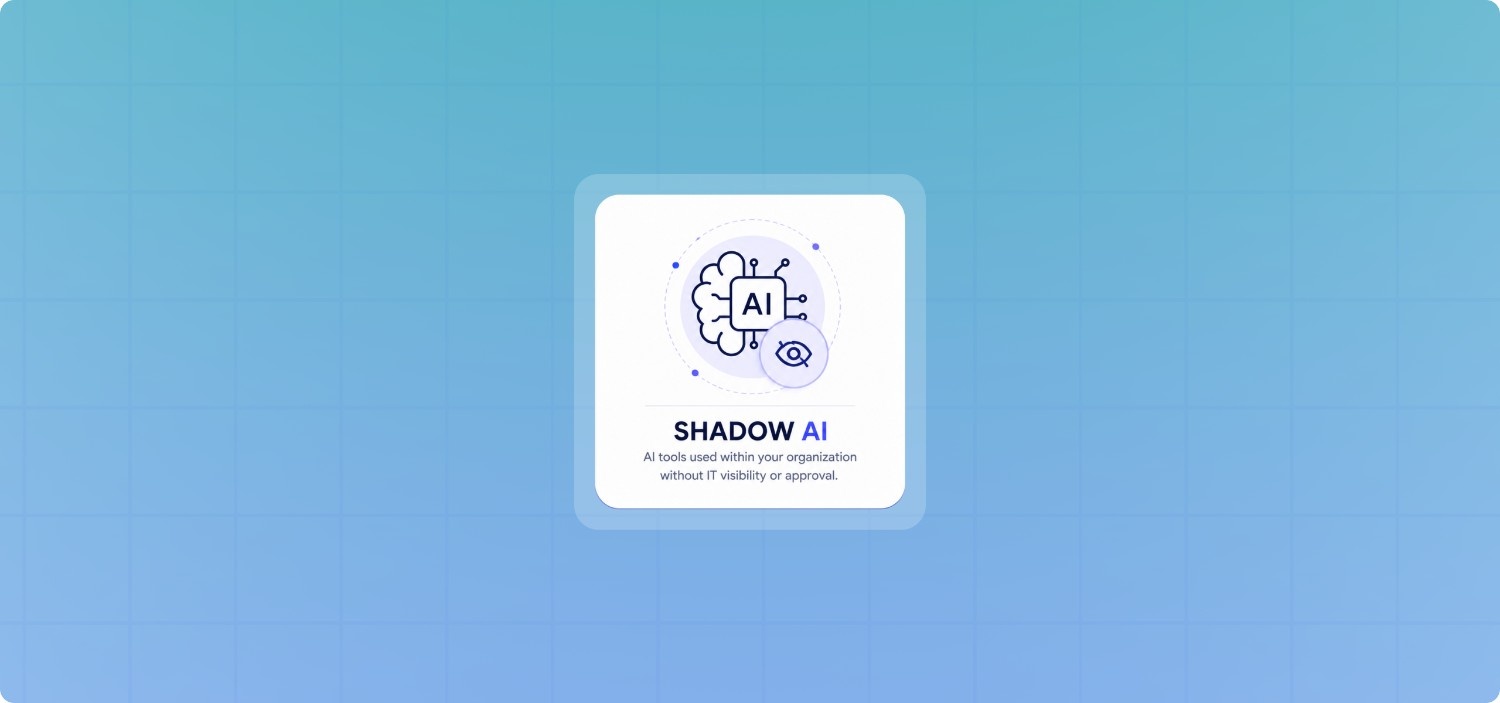
Shadow AI - the AI tools your employees are using without IT's knowledge or approval - is already inside your organisation, and the scale of it might surprise you. 47% of employees using generative AI at work are doing so through personal, unmanaged accounts completely outside your visibility or control (Netskope Cloud and Threat Report, 2026). Meanwhile, the 2026 Nutanix Enterprise Cloud Index found that 79% of IT leaders have already encountered AI applications deployed by employees without IT involvement. That means the ungoverned AI in your environment is not just sitting idle - it is intelligent, actively processing your data, generating outputs, and potentially making decisions without a single governance check.
Does your IT team know which AI tools are active right now? If the answer is anything other than an unqualified yes, this guide is for you.
Shadow AI vs Shadow IT - What Changed
Shadow IT has existed as long as employees have had credit cards and internet access. It refers to any application or system used inside an organisation without the explicit knowledge or approval of IT. A personal Dropbox account for sharing files, an unapproved Slack workspace for a project team, these are the classic examples.
Shadow AI is something categorically different, and the stakes are higher.
Where shadow IT stores or moves data, shadow AI processes it, analyses it, and can act on it - often in ways that are opaque even to the employee using the tool. Unlike traditional shadow IT, shadow AI actively processes, stores and generates data using sensitive business information as input. Shadow AI capabilities make it frictionless for users to paste proprietary data, source code, credentials, or customer information directly into external systems. These interactions are difficult to monitor and rarely leave clear audit trails.
The governance gap this creates is not just a security problem. It is a compliance problem. When an AI model ingests a customer contract, a financial forecast, or an internal strategy document via a free-tier chatbot, the organisation has potentially violated four separate European regulatory frameworks simultaneously - before anyone in IT knew the tool existed.
| Shadow IT | Shadow AI |
Data handling | Stores or moves data | Processes, analyses, and acts on data |
Governance risk | Unapproved software use | Unclassified AI system in production |
Regulatory exposure | GDPR data location | GDPR + EU AI Act + DORA + NIS2 |
Detection difficulty | Moderate (expense reports, SSO) | High (personal accounts, embedded features) |
Consequence severity | Policy violation | Multi-framework regulatory breach |
Why Shadow AI Is Exploding in 2026
Three forces are driving this explosion, and none of them are slowing down.
AI spending is outpacing governance
Generative AI spending worldwide reached $644 billion in 2025, a 76.4% increase from 2024. Investment at this scale means AI capabilities are being embedded into almost every SaaS product employees already use - often silently, without IT ever reviewing a privacy policy or data processing agreement. Gartner further predicts global AI spending will top $2 trillion in 2026.
Employees are adopting AI faster than policy can follow
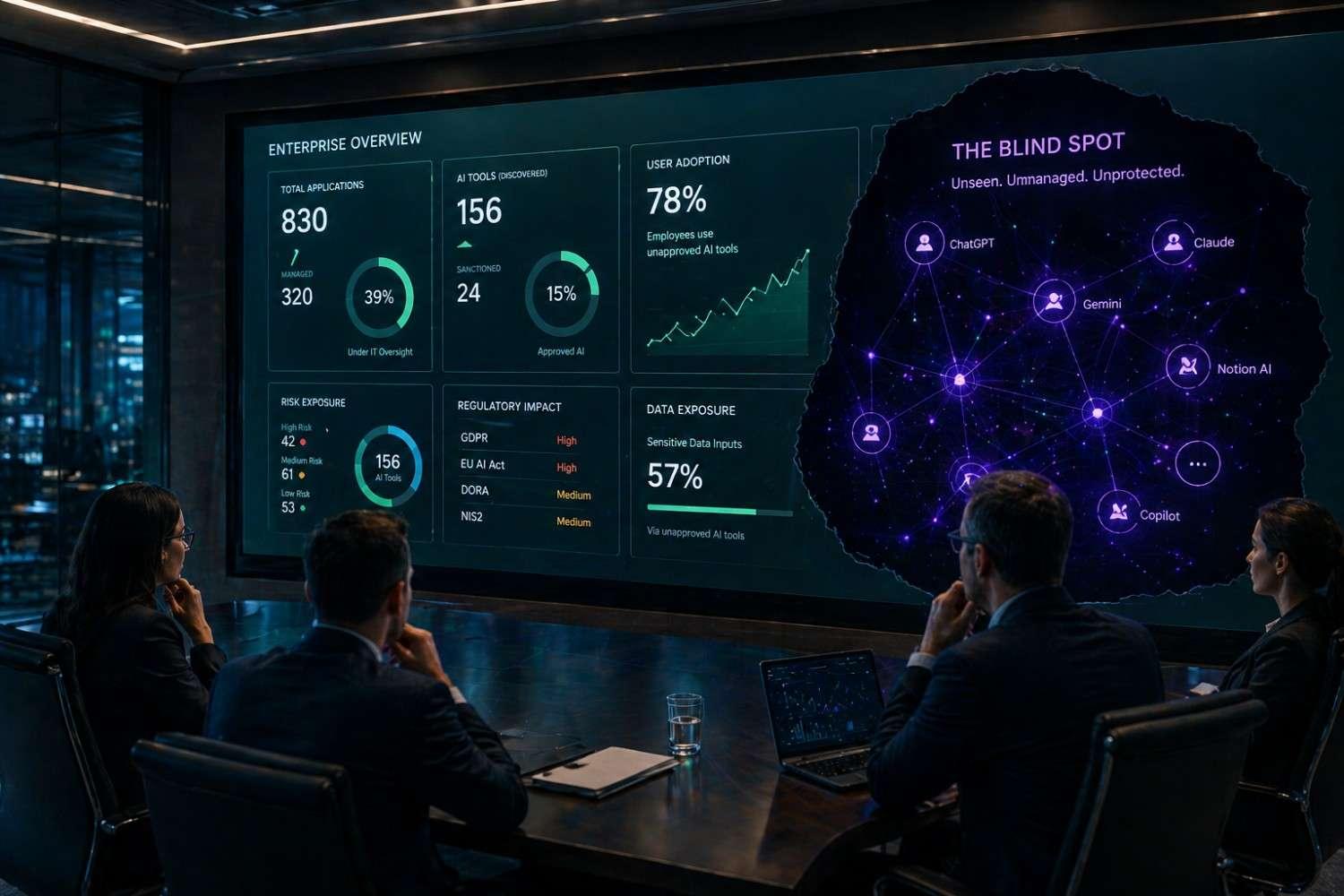
78% of employees admit to using shadow AI tools not approved by their employer. A 2025 report from Menlo, which tracked hundreds of thousands of user inputs over a month, found that 68% of employees used personal accounts to access free AI tools like ChatGPT - with 57% of them inputting sensitive company data.
78% use unapproved AI tools WalkMe 2025 | 68% use personal AI accounts Menlo 2025 | 57% share sensitive data via AI Menlo 2025 |
Personal accounts are the invisible door
47% of employees access AI through personal or unmanaged accounts, dramatically increasing shadow AI exposure (SQ Magazine, 2026). When an employee signs into ChatGPT with a personal Gmail account on a corporate device, the organization has zero visibility: no audit trail, no data processing agreement, and no way to retrieve or delete what was shared.
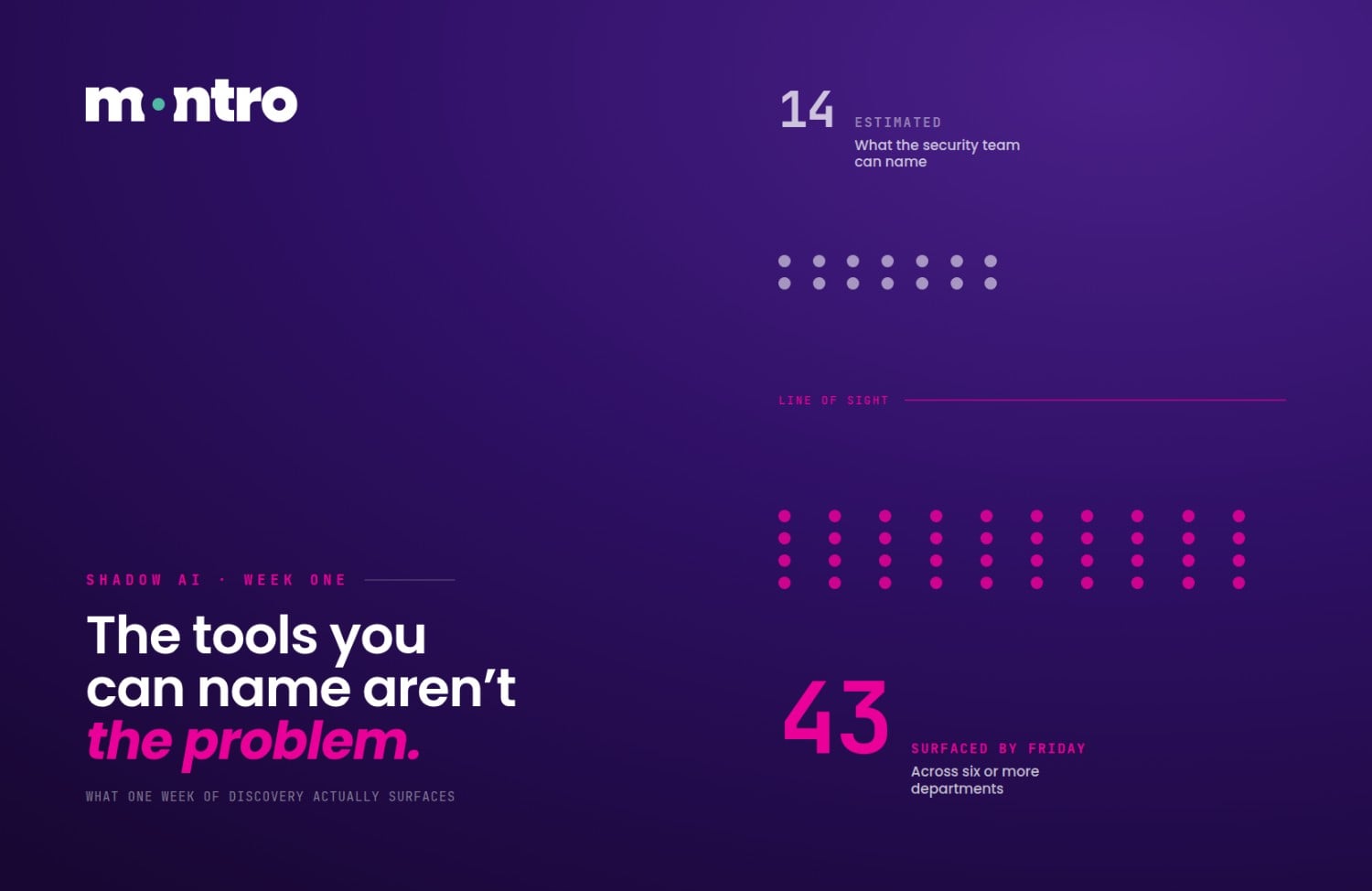
The statistics on shadow AI show what employees and IT leaders know about the tools; they consciously chose to use. What they consistently undercount is the category neither group reports: AI features that arrived inside tools the firm had already approved. When we run discovery audits, this embedded AI category is almost always the biggest finding. Notion AI, Slack AI, Copilot inside Microsoft 365, none of these require a separate decision, they get added to the tools by default when the product is updated, and start processing data. The IT leader counting shadow AI did not think to look inside tools they had already sanctioned. The survey gap is not about honesty , it is about visibility. You cannot report what you cannot see. - Ankur Arora, Co-Founder, Montro |
The Four Real Risks of Shadow AI
One shadow tool. Four violations.
This is not a hypothetical. Consider a single scenario: an employee in your legal team uses a free-tier AI summarisation tool to process customer contracts. They open the tool, paste in three pages of a signed agreement, and ask for a summary. The transaction takes thirty seconds. The exposure lasts indefinitely. Here is what just happened across four regulatory frameworks simultaneously:
1. GDPR - processing without a lawful basis
The personal data contained in that contract - names, addresses, commercial terms - has just been transmitted to a third-party AI system with no data processing agreement, no legitimate interest assessment, and no privacy notice given to the data subjects. This violates Articles 5, 6, and 13 of the GDPR. Most organisations do not control the flow of sensitive data through the tools employees use. This blind spot makes it nearly impossible to demonstrate compliance in an audit or respond to data subject access requests (Proofpoint, 2025). Fine exposure reaches €20 million or 4% of global annual turnover.
2. EU AI Act - an unclassified high-risk system
The EU AI Act requires organisations to assess, classify, and govern AI systems before deployment. If the summarisation tool qualifies as high-risk under the Act - processing legal documents that affect individuals' rights places it under close scrutiny - deploying it without a conformity assessment, transparency documentation, or human oversight mechanism is a direct violation of Articles 9, 10, and 13. Gartner predicts that by 2030, more than 40% of enterprises will experience security or compliance incidents linked to unauthorised shadow AI. The organisation may not even know the system exists, let alone its risk classification, which is why AI risk assessment against the EU AI Act tiers has to be built into the discovery process, not treated as a separate subsequent exercise.
3. DORA - an undocumented ICT third-party dependency
For financial institutions, the Digital Operational Resilience Act (DORA) requires every material ICT third-party provider to be documented, assessed, and governed under a formal contract. The moment an employee routes sensitive financial data through an ungoverned AI tool, the organisation acquires an undocumented ICT dependency entirely outside its resilience framework. Articles 28 and 30 require due diligence, contractual arrangements, and exit strategies - none of which exist for a free-tier AI tool accessed via a personal account.
4. NIS2 - a supply chain security gap
The NIS2 Directive requires organisations in essential and important sectors to manage cybersecurity risks across their entire supply chain, including ICT providers. When breach incidents involving shadow AI occur, IBM's 2025 findings show that 65% involve compromised personally identifiable information, and 40% involve exposed intellectual property. An ungoverned AI tool is an unvetted supplier. Its security posture, data retention practices, and breach notification obligations are entirely unknown - a direct gap in NIS2 Article 21 compliance.
Key takeaway: One employee. One free tool. Thirty seconds of convenience. Four simultaneous regulatory violations. This is not a theoretical risk profile - it is the default state of most European organisations in 2026. |
Shadow AI in Practice - What It Looks Like
Shadow AI does not announce itself. It accumulates quietly, tool by tool, in the gap between what employees need and what IT has approved. Here are four concrete examples your organisation will recognise:
- The legal team's shortcut. A solicitor uses ChatGPT to summarise client contracts before review meetings. Accessed via a personal Google account, client names, commercial terms, and confidentiality clauses are transmitted to a third-party LLM with no data processing agreement. The solicitor saves time. The DPO has no idea.
- The finance team's automation. A finance analyst uses an AI expense categorisation tool discovered through a LinkedIn ad. It connects to the accounting system via OAuth, processes salary data and budget forecasts, and has no SOC 2 certification. Under DORA, this is an undocumented ICT third-party risk.
- The embedded AI nobody noticed. A project management tool the organisation has used for years ships an AI summarisation feature, enabled by default. Employee conversations, task descriptions, and project timelines are now being processed by an AI sub-processor not covered in the original data processing agreement.
- The developer's productivity tool. A software engineer subscribes personally to GitHub Copilot and uses it to write production code. Proprietary algorithms, API keys, and internal system architecture flow into an external AI system. The organisation has no visibility and no contractual protection.
93% of IT leaders report concerns about data security risks from shadow AI tools, including data leaks, unauthorised access, and third-party vulnerabilities. Concern alone, however, does not create visibility, and visibility requires AI tool discovery running continuously, not concern logged in a risk register.
How European Organisations Start Getting Visibility
The only way to govern shadow AI is to first find it. This requires a deliberate methodology - because shadow AI, by definition, is not self-reporting.
Start with a discovery-first approach
Audit your environment before you attempt to set policy. Only 15.5% of applications in the average organisation are formally sanctioned. The rest exist in states of partial awareness, informal tolerance, or complete invisibility. A thorough discovery audit typically reveals four times more applications than IT teams expect.
Effective discovery combines multiple signals simultaneously:
- OAuth grants connected to corporate identity providers
- Browser extension monitoring for AI-powered add-ons
- Expense report analysis to surface direct employee purchases
- Network traffic inspection for AI API calls
- Email metadata analysis to detect SaaS sign-up confirmations
Map discovered tools to regulatory obligations
Every discovered tool must be assessed against all four frameworks. Does it process personal data under GDPR? What is its AI risk classification under the EU AI Act? Is it a material ICT provider under DORA? Has it been security-assessed for NIS2 purposes? Only 37% of organisations have policies to manage or even detect shadow AI (IBM, 2025), meaning the majority are flying blind precisely when European regulators are beginning to scrutinise shadow AI governance most actively.
Build governance for continuous discovery, not annual audits
Software adoption no longer follows centralised or predictable paths - AI tools are being adopted faster than traditional procurement and identity controls were designed to handle. Governance must be a live process: real-time alerts when new shadow AI tools appear, automated AI risk assessment scoring against regulatory frameworks, and clear escalation paths for high-risk discoveries.
Frequently Asked Questions
What is shadow AI?
Shadow AI is any AI tool an employee is using that IT doesn't know about. Free-tier ChatGPT, an AI writing assistant, a summarisation tool someone found on LinkedIn - if it wasn't approved, it's shadow AI. The problem isn't just that it's unapproved. It's that it's actively processing your data while nobody's watching.
How is shadow AI different from shadow IT?
Shadow IT stores or moves data. Shadow AI processes it - often using customer records, contracts, or financial information as inputs. That distinction matters enormously for compliance. One unapproved file-sharing app is a policy violation. One unapproved AI tool processing customer data is potentially a GDPR breach, an EU AI Act violation, a DORA gap, and a NIS2 supply chain failure, simultaneously.
Why is shadow AI growing so fast in 2026?
Because AI is now inside tools employees already use, often switched on by default. Your project management tool, your email client, your CRM - all shipping AI features that IT never reviewed. Add to that the fact that 78% of employees are using AI tools their employer hasn't approved, mostly through personal accounts that leave no audit trail, and you have a visibility problem that grows faster than any policy can keep up with.
What regulations does shadow AI put us at risk of violating?
In Europe, the short answer is all of them. GDPR if there's no data processing agreement in place. The EU AI Act if the system hasn't been classified and governed before deployment. DORA if you're a financial institution and the tool isn't in your ICT register. NIS2 if it represents an unvetted supplier in your supply chain. These aren't sequential risks, they stack.
How do European organisations start getting visibility over shadow AI?
You find it before you govern it. That means combining signals - OAuth grants, browser activity, expense reports, network traffic, email metadata - into one continuous picture. The mistake most organisations make is treating this as an annual audit. By the time the audit runs, dozens of new tools have been adopted. Visibility has to be real-time or it isn't really visibility.