Most banks have a list of approved AI systems. What they don't have is an accurate one.
Walk the trading floor, the credit team, the compliance department. Somewhere in each of those teams, someone is using an AI tool that isn’t on that list. They’re using it because it makes them faster. They have no idea it could make the whole institution non-compliant.
Banks operate more AI systems than almost any other sector. Credit decisions, fraud alerts, customer chatbots, AML screening, investment recommendations - virtually every critical workflow now has an AI layer. Yet according to the World Retail Banking Report 2024, only 6% of retail banks have a full AI plan in action, and 63% still lack adequate AI control frameworks.
That gap is about to become a legal liability. The EU AI Act (Regulation EU 2024/1689) entered into force on 1 August 2024, with high-risk AI obligations for Annex III systems now applying from 2 December 2027, following a 16-month deferral under the Digital Omnibus on AI (Regulation (EU) 2026/1744). Simultaneously, DORA has been in full enforcement since January 2025 - meaning AI vendors your bank depends on are simultaneously subject to ICT third-party risk rules. Together, these two frameworks create the most complex compliance landscape any financial institution has navigated.
"Banks are operating in a compliance perfect storm. The EU AI Act defines what AI systems are high-risk and what you must do about them; DORA governs how you manage those systems as ICT dependencies. Neither regulation can be addressed in isolation - and together, they demand a level of AI governance maturity that most institutions simply haven't built yet." - Namita Razdan, Co-Founder, Montro
Which Banking AI Systems Are High-Risk Under Annex III?
Annex III of the EU AI Act lists the AI use cases automatically classified as high-risk under Article 6(2). For banks, EU AI Act compliance under Annex III, Point 5 - 'Access to and enjoyment of essential private services and essential public services and benefits.'
Below is a mapping of the four most common banking AI use cases to their specific Annex III references:
Banking AI Use Cases Mapped to Annex III
Banking AI System | Annex III Reference & Classification |
Credit Scoring & Creditworthiness Assessment | Annex III, Point 5(b): 'AI systems intended to evaluate the creditworthiness of natural persons or establish their credit score' - explicitly classified HIGH-RISK. |
Loan Origination & Automated Underwriting | Annex III, Point 5(b): Where AI output influences access to lending products for natural persons, high-risk classification applies. Exception: fraud detection excluded. |
AML / KYC Screening (Access Decisions) | Annex III, Point 5(b): When AI-driven AML or KYC screening directly determines whether a customer gains access to banking services, it qualifies as high-risk. |
AI-Assisted Investment Advice | Annex III, Point 5(b): Where AI recommendations determine a customer's access to investment products or services, high-risk obligations are triggered - particularly where robo-advice gates product eligibility. |
Source: EU AI Act, Regulation (EU) 2024/1689, Annex III - Official Journal version, 13 June 2024. European Banking Authority AI Act Mapping Exercise (2025).
EU AI Act Risk Tier Framework: Banking Context
Risk Tier | Banking Relevance | Enforcement |
UNACCEPTABLE RISK | Prohibited outright - social scoring, real-time biometric ID in public spaces (Article 5) | Since 2 Feb 2025 |
HIGH RISK - Annex III | Credit scoring, AML/KYC access decisions, AI-assisted investment advice-heavy obligations apply | 2 Dec 2027 |
LIMITED RISK | Chatbots, virtual assistants - Article 50 transparency disclosures required | Aug 2, 2026 |
MINIMAL RISK | Spam filters, AI playlist curation - no mandatory requirements | Now |
Source: EU AI Act, Regulation (EU) 2024/1689. Enforcement timeline per European Commission and the Digital Omnibus on AI, Regulation (EU) 2026/1744 (2026).
An important distinction: fraud detection AI is explicitly excluded from Annex III Point 5(b) high-risk classification. However, as the German Banking Association has noted, this exclusion does not extend to AI systems where fraud risk assessment directly influences loan pricing or service access - in those hybrid use cases, high-risk obligations re-engage.
⚠ Key Distinction |
Pure fraud detection = excluded from Annex III high-risk classification. |
Fraud risk assessment that influences credit pricing, insurance premiums, or service access = re-enters high-risk classification. |
This boundary is thinner than most compliance teams assume. Document your system's intended purpose carefully. |
What 'High-Risk' Means Operationally for Your Bank
High-risk classification is not a conceptual label - it triggers a specific set of deployer obligations under Article 26. These obligations apply to your bank as the entity deploying the AI system, regardless of whether you built it or procured it from a vendor.
Article 26 Deployer Obligations Applied to Banking
Obligation | Article Ref. | Requirement | Banking Application |
Follow instructions for use | Art. 26(1) | Use AI systems in line with the provider's instructions | Use credit-scoring AI only for approved populations & stated purposes; don't extend to new customer segments without re-assessment. |
Assign human oversight | Art. 26(2) | Assign competent, trained, authorised staff to oversee AI outputs | A qualified credit analyst must be able to interrogate, override and document every AI-assisted credit decision. |
Monitor input data quality | Art. 26(4) | Where the deployer controls input data, ensure it is relevant and sufficiently representative | Where the bank controls data inputs, ensure training/inference data remains relevant and representative. |
Monitor operation & report incidents | Art. 26(5) | Monitor system performance; report risks and serious incidents to the provider and market surveillance authority | Financial institutions may satisfy this through existing CRD/CRR internal governance - but gaps must be documented. |
Retain logs | Art. 26(6) | Keep auto-generated system logs for a minimum of 6 months | AI decision logs must be stored and mapped to existing financial-services log-retention obligations. |
Inform workers | Art. 26(7) | Before workplace deployment, notify workers' representatives and affected employees | Staff whose work is assessed or directed by AI (e.g. AI-assisted performance monitoring) must be notified in writing before rollout. |
Inform affected individuals | Art. 26(11) | Inform natural persons that they are subject to a decision made or assisted by a high-risk AI system | Customers must be told an AI was involved in a credit decision and given a right to explanation (see also Art. 86). |
Source: EU AI Act, Article 26 - Official Journal version (EU) 2024/1689, 13 June 2024. Banking application notes drawn from EBA AI Act implications paper (2025) and Goodwin Law analysis (2025).
Three of these obligations deserve particular attention in a banking context:
Human Oversight in Credit Decisions
Article 26(2) requires deployers to assign human oversight to persons with 'necessary competence, training and authority.' In practice, this means a qualified credit analyst - not just a relationship manager - must be able to review, interrogate, and override every AI-assisted credit recommendation. Logging that override (or non-override) is itself a compliance act.
Fundamental Rights Impact Assessment (Art. 27)
Banks deploying high-risk AI in credit scoring, insurance pricing, or public-sector decision-making must complete a Fundamental Rights Impact Assessment before go-live. This is separate from a GDPR Data Protection Impact Assessment - both may be required.
The 40-60% Gap Advantage
Research from financial services compliance practitioners indicates that 40–60% of the AI Act's high-risk compliance infrastructure may already exist within banks that comply with CRD/CRR and Solvency II requirements. Article 26(5) explicitly allows financial institutions to satisfy the monitoring obligation through their existing internal governance frameworks. The priority is gap analysis, not building from zero.
Compliance Efficiency Note |
Article 19(2): Banks may satisfy AI Act quality management system requirements through their existing sectoral QMS. |
Article 26(5): Deployers that are financial institutions may fulfil AI Act monitoring obligations via CRD/CRR internal governance. |
Result: The compliance lift is real but not starting from scratch - structured gap analysis is the critical first step. |
The DORA Intersection - Your AI Vendor Is Also an ICT Third-Party
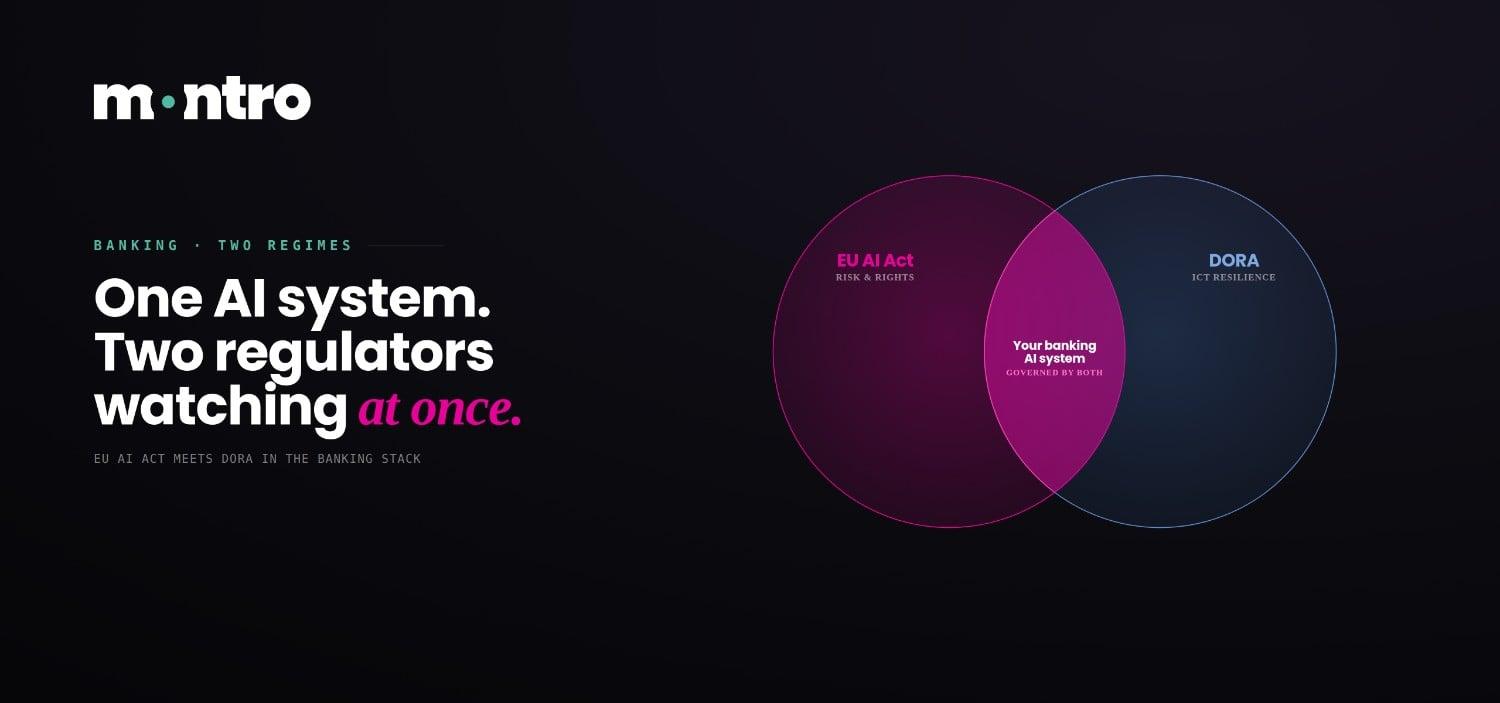
Here is the compliance complexity that most banks have not fully mapped: every AI system your bank deploys from an external vendor is simultaneously governed under two distinct regulatory regimes - the EU AI Act (risk classification and AI-specific obligations) and DORA (digital operational resilience and ICT third-party risk management).
DORA has been in full enforcement since 17 January 2025. It requires banks to maintain comprehensive ICT risk management frameworks covering all technology services they depend on. When your bank routes customer data through an external AI API - whether for compliance screening, credit scoring, or customer advisory - that API constitutes part of your ICT risk surface under DORA.
Dual Regulation: The Same AI System Under EU AI Act & DORA
Regulatory lens | EU AI Act | DORA |
Primary concern | Risk to fundamental rights & safety | Operational resilience & ICT continuity |
Trigger for AI vendor | High-risk classification (Annex III) | Critical ICT third-party dependency |
Key documentation | Technical docs, conformity assessment | ICT register, contractual provisions |
Incident reporting | Serious incidents to market authority | Major ICT incidents to competent authority |
Convergence point | AI Act Art. 26(5) - financial institution logs align with DORA ICT log requirements | |
Source: EU AI Act (2024/1689) Article 26; DORA (EU 2022/2554) Articles 17, 28–30. Analysis from K&L Gates (January 2026), Pinsent Masons, EIOPA.
The ICT Register is where most banks currently have a gap. DORA requires a complete register of ICT third-party arrangements - but many banks' registers were built to capture traditional technology vendors, not AI system providers. If your credit-scoring AI vendor is not in the ICT register with documented contractual provisions, audit rights, and incident notification obligations, you have a DORA exposure today, not an AI Act exposure in 2026.
Concentration risk is the second pressure point. DORA was explicitly designed to address the financial sector's reliance on a small number of ICT providers. If multiple banks are using the same AI vendor for credit scoring or AML screening, supervisory authorities will apply concentration risk scrutiny to that vendor — and to the banks that depend on them.
Practical Action: Three Steps for the DORA/AI Act Intersection |
1. Audit your ICT register - identify every external AI vendor and confirm they appear as an ICT third-party arrangement. |
2. Review contracts - confirm audit rights, incident notification timelines, and SLA terms meet DORA Article 30 requirements. |
3. Assess concentration risk - if more than one of your critical AI systems is with the same provider, document your concentration risk assessment per DORA guidance. |
What Montro Finds in Banking ICT Registers |
The ICT registers that Montro reviews in financial institutions almost all the time have the same problem. The AI vendor is present, the contract reference is documented, but the Article 30 provisions are not there. The register does not mention the audit rights, incident notification timeline, or the sub-processor list. The register was built for software vendors, not for AI systems, and DORA does not make that distinction. The exposure is there today regardless of whether the August 2026 AI Act deadline feels distant. |
Customer-Facing AI - Transparency Obligations
Not all banking AI falls into Annex III's high-risk category. Customer-facing AI - chatbots, virtual assistants, robo-advisors, and AI-generated financial content - is typically classified as 'limited risk' under Article 50, which introduces its own mandatory transparency obligations applicable from August 2026.
What Article 50 Requires for Banking Chatbots
Under Article 50(1), providers must ensure AI systems designed to interact directly with natural persons are built to inform those persons that they are interacting with an AI. For banks, this creates a specific operational requirement: every customer-facing AI channel - the in-app assistant, the telephone IVR with AI routing, the website chat - must disclose its AI nature at or before the point of first interaction.
The disclosure cannot be buried in terms and conditions. It must be timely, clear, and accessible to a 'reasonably well-informed, observant and cautious' person. For a retail bank customer asking whether they qualify for a mortgage, a small 'AI' icon in the corner of a chat window is unlikely to meet this standard.
AI-Generated Financial Content
A grey area with significant banking exposure: where AI is used to generate market commentary, economic outlooks, or investment analysis that is published with the purpose of informing the public on matters of public interest, Article 50(3) requires disclosure that the content was artificially generated. Banks producing AI-generated research notes or regulatory briefings will need a documented editorial workflow identifying responsible persons - not merely a claim that human review occurred.
Article 50 Disclosure Checklist for Banks |
☐ All customer-facing AI channels disclose AI nature at first interaction. |
☐ Disclosure is prominent, timely, and not limited to small print or T&Cs. |
☐ AI-generated financial content for public consumption is labelled. |
☐ Documentary evidence of editorial review workflow is maintained. |
☐ Deepfake or AI-manipulated content in marketing carries explicit disclosure. |
Shadow AI in Banking - The Hidden Exposure
While compliance teams focus on the sanctioned AI systems in the ICT register, a parallel compliance risk is growing invisibly: shadow AI. These are the AI tools your employees are using right now, without IT approval, governance oversight, or any entry in your AI or ICT register.
According to UpGuard’s November 2025 report, more than 80% of workers - including nearly 90% of security professionals, use unapproved AI tools in their jobs. In banking, shadow AI manifests in ways that are particularly high-stakes:
- Traders using consumer AI tools for market analysis or trade ideation, generating outputs that influence regulated decisions but leave no audit trail.
- Relationship managers using AI to draft client communications or personalise outreach, potentially using confidential client data in unsanctioned platforms.
- Credit analysts using AI to pre-screen applications or generate internal risk summaries, creating de facto AI involvement in high-risk decisions with no governance framework.
- Compliance staff using AI to interpret regulatory guidance, with no controls on data inputted or outputs relied upon.
The EU AI Act's accountability framework assumes you know what AI systems your bank is using. Article 26 obligations attach to the deployer - your bank - regardless of whether the use was formally sanctioned. If a trader's use of an external AI tool influences a regulated decision, your bank may bear deployer obligations for a system it never onboarded, never assessed, and never logged.
DORA compounds this: an unsanctioned AI tool that processes client data or influences operational decisions is, by definition, an unmanaged ICT dependency. It is invisible to your ICT risk framework, unassessed for concentration risk, and absent from the registers regulators will review.
Shadow AI Risk Reality for Banks |
EU AI Act: Deployer obligations (Art. 26) attach based on actual use - not formal onboarding. |
DORA: Unregistered AI tools that influence operations are unmanaged ICT exposures - fully in scope. |
GDPR: Employees inputting client or customer data into consumer AI platforms may constitute a reportable data breach. |
Market Conduct: Unlogged AI influence on trading or investment decisions creates regulatory and conduct risk. |
Solution: Discovery-first. You cannot govern what you cannot see. |
The practical implication is not a ban on AI tools - it is a discovery mandate. Before any EU AI Act compliance framework can be built, banks need comprehensive visibility into every AI tool in use across every team, whether sanctioned or not. That includes the AI features embedded in existing SaaS products, which research suggests could mean 50 or more active AI applications in a mid-sized institution - most ungoverned.
Where to Start: The Discovery Imperative
The EU AI Act's high-risk obligations for Annex III systems now take effect on 2 December 2027, following the Digital Omnibus deferral. The fines are real: up to €15 million or 3% of global annual turnover for non-compliance with deployer obligations under Article 26 - with the higher €35 million or 7% band reserved for prohibited-practice violations under Article 5 - and enforcement falling to your existing sector regulator, the EBA for banks. But the more immediate risk is operational: banks that have not mapped their AI landscape cannot demonstrate to regulators, or to themselves - that they are compliant.
The sequence is straightforward, even if the execution is not.
- Discovery first: identify every AI system in use, sanctioned and unsanctioned. Management-declared inventories are typically 30–50% incomplete.
- Classification second: apply the Annex III AI risk classification framework to determine which systems are high-risk.
- Obligation mapping third: apply Article 26 requirements and confirm DORA ICT register alignment for every vendor.
- Then build governance: systematically, with the understanding that existing financial regulation provides a significant head start, but only if the foundation is complete.
The hard part is not building the governance framework. The hard part is knowing the full extent of what needs to be governed. That’s the discovery problem. And it’s the one most institutions have not solved.
BOOK A DISCOVERY AUDIT
See every AI tool in your banking stack mapped against EU AI Act and DORA.
Montro's Discovery Audit identifies sanctioned and shadow AI systems across your organisation, classifies each against Annex III, maps your Article 26 gaps, and cross-references your DORA ICT register - giving compliance officers and CISOs a single, defensible view of AI risk.
Frequently Asked Questions
Does the EU AI Act apply to banks that use third-party AI systems they did not build themselves?
Yes, and this is where most banks' compliance programmes have a gap. The EU AI Act applies to deployers, not just providers. A bank using a third-party credit scoring model, AML screening platform, or AI-powered fraud detection system is a deployer under Article 3(4), and Article 26 obligations apply from the moment that system is in live use. The fact that the bank did not build the AI is irrelevant to the compliance obligation. What matters is that the bank is using it under its own authority for its own operational purposes, which is precisely what deployer status means.
How does the fraud detection AI exclusion from Annex III actually work in practice?
Annex III Point 5(b) includes a carve-out for AI specifically intended to detect financial fraud, but the exclusion is narrower than most compliance teams assume. It covers AI whose purpose is fraud detection in isolation. The moment a fraud risk score begins to influence loan pricing, service access decisions, or account closure, the system is operating in hybrid territory. In those cases the high-risk classification re-engages because the output is no longer purely fraud detection, it is affecting an individual's access to financial services, which is precisely what Point 5(b) is designed to govern. Any system where fraud risk feeds into credit or access decisions should be assessed as potentially high-risk regardless of how the vendor has categorised it.
What does Article 26(2) human oversight actually require for credit decisions, and who qualifies?
Article 26(2) requires oversight to be assigned to individuals with the necessary competence, training, and authority to intervene, override, or suspend the AI system's outputs. In a credit context, this means a qualified credit analyst, not a relationship manager whose role does not include credit risk assessment. The oversight must be genuine: a person who has the authority to override but no practical mechanism to do so, or who lacks the technical understanding to interrogate the AI's recommendation, does not satisfy the obligation. Logging the override decision, or the decision not to override, is itself a compliance act under Article 26.
If a bank's employee uses an unsanctioned AI tool for a task that influences a regulated decision, does the bank have an EU AI Act exposure?
Yes, and this is one of the least understood aspects of the Act's accountability framework. Article 26 obligations attach to the deployer, which is the bank, regardless of whether the use was formally sanctioned. If a credit analyst uses an external AI tool to pre-screen an application and that output influences the final decision, the bank may bear deployer obligations for a system it never onboarded, never classified, and never logged. The Act does not provide a safe harbour for unsanctioned use. This is why discovery, knowing every AI tool in use across every team, is a compliance prerequisite, not an operational nice-to-have.